
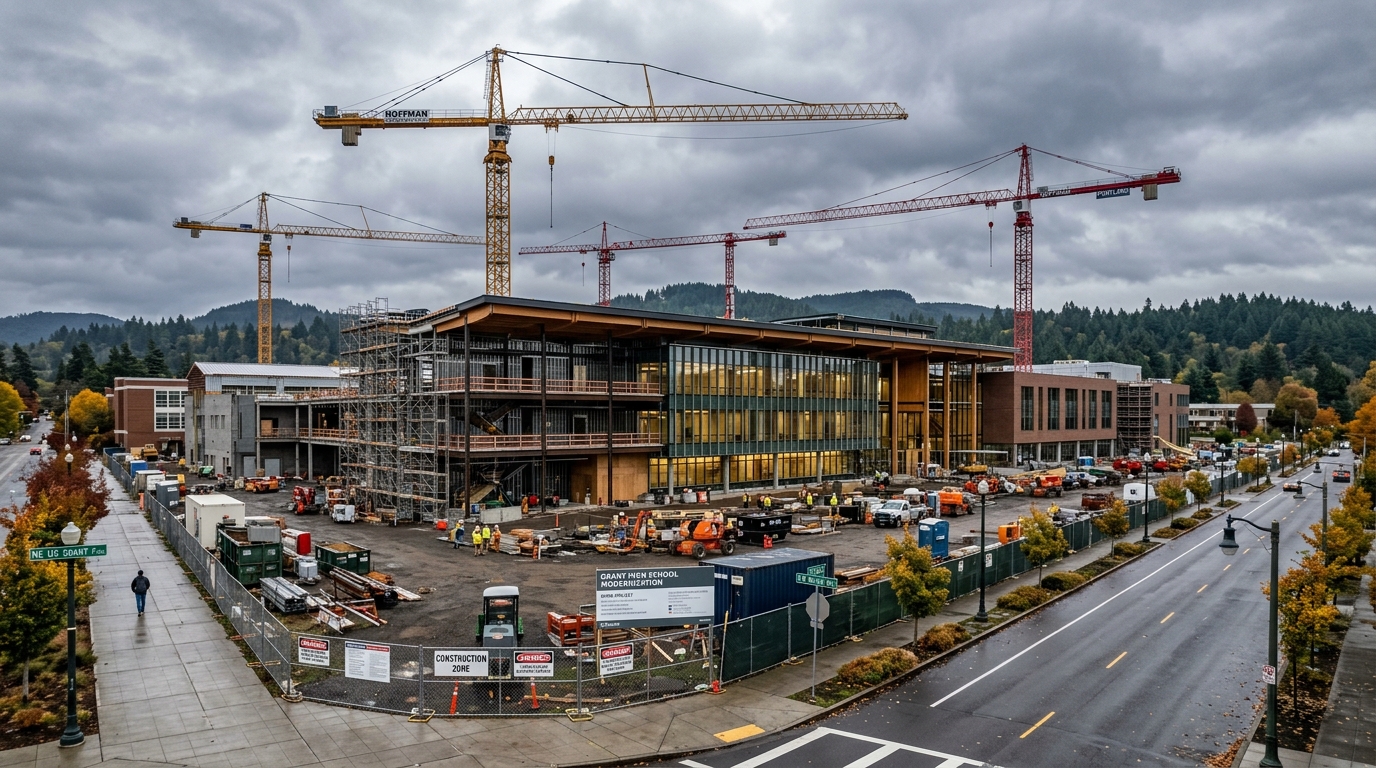
Portland Public Schools (PPS) has achieved a national distinction that should alarm every taxpayer and parent in Oregon: the district is building the most expensive high school remodels in the history of the United States.
While public school districts across the country construct modern, state-of-the-art comprehensive high schools for $70 million to $130 million, Portland has pushed price tags past $400 million, and in some cases approaching half a billion dollars for a single school. At the exact moment families are fleeing Portland classrooms in droves, PPS leadership is pouring billions into lavish architectural monuments designed for thousands of students who simply do not exist.
Half-Billion Dollar Price Tags
The modernization budgets for Portland high schools have completely detached from reality. A review of recent and active capital projects reveals numbers that resemble luxury private developments rather than public school renovations:
- Jefferson High School ($491 Million): Originally allocated $366 million under the 2020 voter-approved bond, the projected cost of modernizing Jefferson High School in North Portland exploded to $491 million. Built to accommodate 1,700 students, the rebuild comes out to an astonishing $288,000 per student seat. For context, Jefferson enrollment has historically hovered around 500 to 600 students, meaning taxpayers are spending hundreds of millions of dollars on empty capacity.
- Benson Polytechnic High School ($410 Million): Completed in 2024, the modernization of historic Benson Tech was originally presented to voters with a projected budget of $202 million to $269 million. The final price tag exceeded $410 million. The project sparked bitter legal claims between PPS and general contractor Andersen Construction over runaway delays, project management failures, and massive scope additions.
- Lincoln High School ($245 Million): Rebuilt in downtown Portland, Lincoln was budgeted at roughly $187 million when the 2017 bond passed. In short order, the cost surged to $245 million due to design revisions and site complexity.
- Cleveland and Ida B. Wells High Schools ($400M to $500M Each): The next high schools in line, Southeast Portland's Cleveland and Southwest Portland's Ida B. Wells, are already projected to cost between $400 million and $491 million each.
Taken together, the modernization of just three high schools (Jefferson, Cleveland, and Ida B. Wells) is projected to consume nearly $1.4 billion in taxpayer funding.
The Most Expensive High Schools in America
To understand just how extreme Portland's spending has become, one only needs to look across district lines and across state borders.
In neighboring Washington County, the Beaverton School District replaced Beaverton High School for approximately $250 million. That facility serves more than 2,000 students, delivering modern career-technical facilities, seismic safety, and cutting-edge labs at a fraction of Portland's cost per student. Nationally, the median cost to build a brand-new high school sits between $60 million and $120 million.
An analysis by the Cascade Policy Institute confirmed that Portland's projects are among the most expensive public high school construction projects ever undertaken in the United States.
Why does a Portland high school remodel cost three to four times more than high schools anywhere else?
District officials routinely blame local inflation and historic preservation requirements, but watchdog reports and internal audits reveal a pattern of unchecked gold-plating:
- Extreme Seismic Mandates: PPS mandated Category IV seismic resilience standards across its modernizations. Category IV is the highest standard in structural engineering, normally reserved for essential emergency facilities like trauma hospitals, police command centers, and fire stations. Oregon building code only requires Category III for public schools. Building high schools to withstand catastrophic direct earthquakes as operational emergency command posts added tens of millions of dollars to structural frameworks.
- Lavish Architectural Finishes: The district consistently prioritized expensive green certifications, specialized artisanal woodwork, custom architectural glass curtain walls, and complex atrium designs over cost containment.
- Runaway Scope and Weak Oversight: Bond project scopes expanded relentlessly without fiscal guardrails. Rather than keeping construction management accountable in-house, the PPS school board approved a controversial $61.5 million program management contract with Texas-based firm Procedeo. That contract was formally referred in September 2026 by Oregon Secretary of State Tobias Read to the Oregon Department of Justice for criminal investigation and the Oregon Government Ethics Commission over allegations of cronyism, bid rigging, and ethics violations.
Building Palaces for Phantom Students
If Portland was experiencing an unprecedented population boom, massive construction budgets might at least have a logistical defense. But the demographic reality is the exact opposite: student enrollment in Portland Public Schools is collapsing.
Between the 2018-2019 school year and the 2025-2026 school year, PPS lost more than 6,000 students. Total district enrollment fell to just 42,622 students.
The decline is not a temporary dip. According to official long-term forecasts by Portland State University's Population Research Center, PPS enrollment is projected to drop another 14 percent over the next decade, plunging to roughly 36,763 students by the 2035-2036 school year.
In high schools specifically, demographic models project that PPS will have approximately 3,000 empty high school desks by 2030 to 2035.
At Benson Polytechnic, the newly opened $410 million facility already serves significantly fewer students than its 1,700-seat design. At Jefferson, the gap between enrollment and capacity was so glaring that district bureaucrats had to orchestrate the "Jefferson Is Rising" boundary overhaul. The district stripped away dual-assignment enrollment choice from neighboring families, forcibly reassigning students into Jefferson simply to manufacture attendance numbers and justify building a half-billion-dollar complex.
The Bitter Irony: Shuttering Neighborhood Elementary Schools
While the PPS school board commits billions to gold-plated high school palaces, how is the district treating neighborhood classrooms?
By preparing to shut them down.
Hobbled by declining per-pupil state funding, dropping enrollment, and a severe structural operating deficit, PPS is currently moving to implement a district-wide "rightsizing" plan. The district has presented two scenarios to the community:
- Scenario A: Permanently closes 14 neighborhood schools (13 elementary schools and 1 middle school).
- Scenario B: Closes 11 neighborhood schools, paired with extensive boundary disruptions and school consolidations.
A formal recommendation from the superintendent is expected in December 2026, with closures taking effect in fall 2027.
The injustice of this dynamic is breathtaking. Working families who bought homes based on proximity to walkable, cherished neighborhood elementary schools are being told their community hubs must close to save a few million dollars in operating funds. Yet just a few miles away, PPS leadership is spending $491 million on a single high school that will sit quarter-empty.
Capital bond funds and general operating funds occupy separate legal buckets, but they come from the exact same source: the Portland taxpayer. When a district claims it has no money to keep basic neighborhood schools open while simultaneously asking voters for billions in bonds to construct the most expensive buildings in America, public trust is completely shattered.
The Broken Bond Machine
Portland voters have supported school bond measures for more than a decade, approving massive packages in 2012, 2017, and 2020. Voters were told these investments were urgent and essential to fix leaky roofs, remove asbestos, replace contaminated lead pipes, and provide safe, functional learning spaces.
Instead, PPS turned capital bonds into an endless gravy train for specialized consultants, architects, and bureaucratic empires. Every bond measure has failed to deliver its promised scope on budget, creating self-inflicted shortfalls that administrators then use to demand the next, even larger bond measure.
Meanwhile, educational performance across Portland has deteriorated. Oregon suspended basic reading and math graduation competency standards through 2028. Proficiency rates on state assessments have stagnated, and chronic absenteeism remains rampant.
Portland parents are not leaving because the buildings lack custom architectural timber or LEED Platinum atriums. Families are leaving because basic academics have been subordinated to ideological activism, classroom safety is ignored, and neighborhood schools are neglected.
Demanding Fiscal Sanity
Portland does not need $491 million monument high schools with empty classrooms. It needs safe, clean, well-maintained neighborhood schools where students are taught how to read, write, and excel in math and science.
Parents and taxpayers must demand immediate reforms:
- Halt and Right-Size Cleveland and Ida B. Wells: Stop current plans for $400M+ builds at Cleveland and Ida B. Wells immediately. Conduct a transparent, outside audit to scale down square footage and seismic specifications to state standards, saving hundreds of millions of dollars.
- Align Facility Size With Real Enrollment: Stop designing schools for 1,700 seats when demographic projections prove those students do not exist. Building for phantom enrollment is willful waste.
- Protect Neighborhood Elementary Schools First: Before closing 11 to 14 neighborhood schools, PPS must eliminate top-heavy central office administration and cancel exorbitant outside management contracts like the $61.5 million Procedeo deal.
- Enact Real Bond Oversight: The Bond Accountability Committee must be granted true independent oversight and public veto power over runaway change orders, ending the culture of rubber-stamping budget blowouts.
Until Portland Public Schools proves it can manage money responsibly and focus on basic academic excellence, taxpayers should reject any future bond proposals. It is time to put students ahead of monuments.